 zadesta
Deliver more without asking people to work harder.
Public-sector teams rarely have an effort problem. They have a process problem. Zadesta finds where work stalls between steps, teams, and systems, then rebuilds the flow so delivery becomes faster, more consistent, and easier to stand behind.
However sound the mandate, people judge it by how long it takes and how clearly it was explained.
Three places public-sector work slows down.
Not policy, and not people. The friction usually sits in handoffs, queues, and the space between departments that nobody formally owns.
Service Delivery & Backlog
Applications, cases, and requests that sit longer than the work itself takes. We map the real path and remove the waiting between steps.
- Intake and triage review
- Queue and backlog analysis
- Turnaround time mapping
- Rework and error-loop removal
Cross-Department Coordination
Work that crosses teams tends to lose time at every boundary. We make handoffs explicit and give each one a clear owner.
- Handoff and ownership mapping
- Shared-service workflow design
- Escalation path clarity
- Decision-rights alignment
Public-Facing Clarity
Much of the frustration the public reports is not about speed. It is about not knowing what happens next, or when.
- Next-step communication design
- Status and update models
- Form and correspondence review
- Enquiry-volume reduction
Improvement that survives audit, turnover, and scrutiny.
Public-sector change carries constraints private-sector work does not. These are the conditions we design within, not around.
Accountability stays intact
We do not redesign around approval chains, records requirements, or statutory obligations. Anything we propose has to hold up when it is examined.
Remove delay before adding resource
Most backlogs are not capacity problems. We look for the waiting, duplication, and rework first, because that capacity is already paid for.
Built for real staffing
Solutions must work with the establishment you have, including vacancies, rotation, and competing priorities. A design that needs ideal conditions is not a design.
It has to outlast us
We document the new process so it survives staff movement. Improvement that lives in one person's head is not improvement, it is a dependency.
Different mandates, the same three bottlenecks.
The subject matter changes. The shape of the delay rarely does.
Intake & Public Counters
Where volume meets limited staff, and where a form designed badly upstream becomes an enquiry queue downstream.
Case & Program Administration
Assessment, eligibility, and approval work where files wait between reviewers far longer than they are actively worked on.
Shared & Corporate Services
Procurement, HR, finance, and reporting functions whose delays quietly set the pace for every operational team they serve.
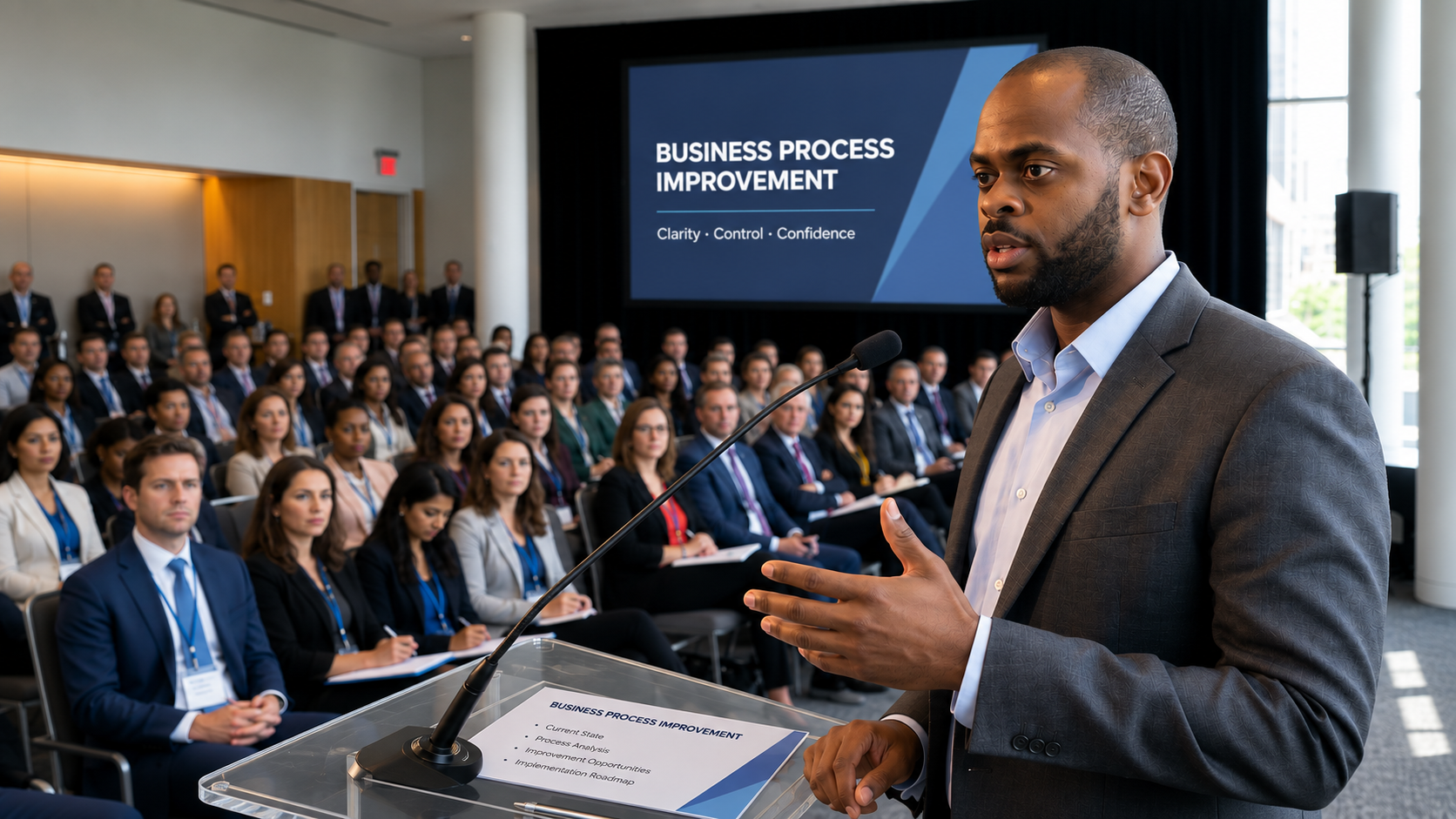
We have worked inside public systems, not just alongside them.
Our director's background spans operational improvement inside the UK's National Health Service, and data analysis, process delivery, project management, and policy review within the Canadian public system.
That matters here. Public-sector improvement fails when it ignores how decisions actually get approved, how records must be kept, and how much scrutiny a change has to withstand. We have worked under those conditions, so we design for them from the start.
Faster. Clearer. Steadier.
The measure is not activity. It is whether the public gets an answer sooner and your teams feel less pressure delivering it.
Faster
Shorter turnaround on the work that matters most, achieved by removing waiting rather than demanding more output.
Clearer
People know where their case stands and what happens next, which reduces both anxiety and the enquiry volume it generates.
Steadier
Consistent delivery regardless of who is on shift, because the process is documented rather than remembered.
Public trust is not won in policy. It is won in turnaround time.
Clarity of movement, quality of flow, strength of execution
Start with the bottleneck you already know about.
Most teams can name the process that costs them the most. A focused conversation about that one is the fastest way to see whether we can help.